

Even today, the sharp smell of Gorgonzola cheese makes me gag.
All it took was a single run-in with an industrial ammonia plant, and now I can barely even look at that stuff.
It happened during the winter of 2011, when I was pulled from the fire station and shipped off to San Jose, California, for months of haz-mat specialist training. My department needed me certified, as our emergency calls were increasingly related to unknown chemicals and terrorist threats.
Between endless hours spent learning how to identify and handle live chemical agents, explosives, and every other nightmare substance you can imagine, we were constantly loaded onto buses for off-site visits to nearby chemical plants. The training was both extremely technical, but also somewhat simple. Part of the day was spent studying chemistry and specialized equipment handling, while the rest of the day was spent on putting it all to use in the field.
A couple of months into my training we visited an industrial scale ammonia manufacturing facility. This location used the Haber-Bosch process, which reacts nitrogen from the air with hydrogen at high temperatures and pressures using an iron-based catalyst. But the most important thing I can remember from this day was the smell.
There’s an incredible amount of research that links smells to memories. One random sniff of a specific scent can trigger immediate and vivid memories of a specific time and place.
That’s what ammonia does to me.
It reminds me of that facility in San Jose. The tanks, pipes, sounds, and incredible amount of infrastructure that I wouldn’t be able to rebuild on my own, even if I had an entire lifetime.
What’s incredible, beyond the smells, is that there are nearly 15,000 similar chemical factories across the United States owned by thousands of individual companies. Some of these companies, which are publicly traded, are currently valued for less than their replacement cost.
The market is wrong. And that’s your opportunity.
Building Blocks of Society
Ammonia is just one of thousands of different chemicals that are manufactured in the US and around the world. Each of these chemicals rarely makes it to the consumer market on their own. Instead they are usually used as precursors for everything from fertilizers to plastics.
Literally everything you touch or are using in this exact moment was built by combining numerous different chemicals. Every day, the average human touches or consumes at least 100 different kinds.
It’s impossible to imagine a future where we are not using chemicals, as they are relied on for our food, clothing, housing, and basic survival. And, as technologies advance, it’s certain that we’ll become even more dependent.
Despite this reliance, markets are almost completely forgetting about the basic commodities that our lives depend on. Similar to the situation with oil that I recently outlined, I believe there is an enormous opportunity within the chemical industry that is hiding in plain view.
Geopolitical Shock – My Chemical Thesis Changed Overnight
I started to write all of this about a month ago, before the war in Iran started.
Now, the exact chemical companies I was eluding to have seen parabolic moves to the upside. And there might be a lot more to come.
I don’t need to give you an overview of what’s happening in the world right now. With the Straight of Hormuz effectively closed, petrochemical exports from the Middle East have all but stopped, creating massive price volatility for various materials around the world.
Some things, like gasoline and diesel have seen obvious changes to the upside. Others, like food commodities and certain metals, have seen unbelievable daily swings as the market tries to figure out what is going to happen.
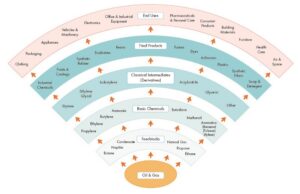
Like I mentioned earlier, specialty chemicals are required to manufacture nearly everything we encounter on a daily basis. And even more importantly, oil and gas are needed to manufacture those specialty chemicals.
Source: CER
Because oil and gas supplies for international markets have been significantly disrupted, those 15,000 US chemical facilities have become incredibly strategic. That’s especially true when you consider that the United States is a net oil and gas exporter. In other words, it’s possible that the final products that specialty chemical companies in the US produce could have massive margins when selling their products in to the world market. Cheaper US oil and gas inputs with more expensive specialty chemical outputs.
Of course, not all chemical companies will see benefits. The type and price of their feedstocks will create a highly volatile market with big winners, and losers.
Oil & Gas Alchemy
Ideally, we want to look for companies that manufacture chemicals using US-based feedstocks (which is cheap, abundant natural gas and oil that we produce right here at home). These aren’t the giant commodity giants that swing wildly with every barrel of oil. We’re talking about specialty chemical producers that turn low-cost inputs into high-value products that the world can’t live without.
The war in Iran has created massive volatility, but it might also be making a structural advantage for American manufacturers. Cheaper domestic energy means fatter margins on the output side, especially when global competitors in the Middle East are offline.
It’s simple alchemy: low-cost feedstock in, premium-priced specialty chemicals out, sold into a world that suddenly has a shortage.
But not every name will capture this opportunity. The winners will be the ones with integrated US plants, strong balance sheets, and exposure to end-markets that stay resilient no matter how crazy energy prices get (think agriculture, autos, electronics, and infrastructure). That’s where the real opportunity sits right now.
Specialty Chemicals – A Smarter Bet
The market looks like it might be noticing what I learned smelling ammonia in that California plant back in 2011. Those chemical facilities aren’t basic factories. Instead, they’re national strategic assets. And specialty chemical companies are the ones best positioned to turn that reality into profits.
Unlike pure commodity plays that live and die by the price of a single feedstock, specialties give you pricing power, recurring demand, and the ability to pass through higher costs. The longer we see supply shocks, the more essential they’ll become. Your cell phone, the fertilizer on your neighbor’s yard, the coatings on the bridge you drive over every day don’t exist without them.
And now, with Middle Eastern supply choked off, US producers can charge global prices while paying domestic energy costs (albeit more expensive than a couple months ago). The parabolic moves we’re seeing in the sector in the past couple of weeks probably aren’t the top… Those moves are more like a multi-year re-rating. The same kind of re-rating we’ve seen with precious metals, like platinum (which I had been screaming about).
Replacement costs for these plants are skyrocketing due to already increasing labor costs and rampant inflation. Despite the massive amount of money it’d take to build new facilities, many specialty chemical companies are trading for single digit P/E ratios and offer healthy dividends.
Gorgonzola Smells Like Profit?
If any name feels personal to me after that 2011 training, it’s AdvanSix ($ASIX). This company makes nylon-6 resin, caprolactam, phenol, and acetone that go into everything from airbags and carpets to electronics and industrial coatings. They also produce ammonium sulfate fertilizer… The exact nutrient product that’s now in short supply globally because of the disruptions through the Straight of Hormuz.
What makes AdvanSix special is its fully integrated US footprint. They run on cheap domestic natural gas, have a disciplined $30 million annual cost-savings plan already in motion, and have a P/B ratio around 0.7. That is ridiculously cheap for a business whose replacement value keeps climbing everyday the Iranian conflict drags on… And everyday the US goes further into debt, only accelerating the re-emergence of the USD printing press!
The likely fertilizer crisis from the war is a direct tailwind for AdvanSix’s agriculture business and their nylon products are tied to autos and construction that aren’t going anywhere. Although, to be fair, if we have an economic downturn, their nylon division could be more a liability. Still, the company is so cheap, I wonder if that’s not even something to worry about?
There are dozens of other similar companies that trade in the US and throughout the world that could be in similar situations. Companies like Eastman Chemical ($EMN), Huntsman Corporation ($HUN), and CVR Partners ($UAN) are all worth keeping an eye on.
All of those companies (and many others) have been operating for the past several years in extremely challenging conditions (especially from competitors that have unfair advantages due to government subsidies). Now as the tide changes, those companies who have remained disciplined for the past decade could see enormous windfalls.
Second Order Profits
In the past, I’ve often talked about second and third order consequences in investing. Right now, as we see oil prices swing wildly, most investors are trying to scalp off profits from this crazy volatility. But the bigger picture we should all be looking at relates to what these price swings will effect.
Late last year, I explained in detail why oil was a major opportunity. Then, just a couple months ago, I went to Canada to make sure I was investing in the right oil and gas companies.
Now that we’ve seen oil and gas run up dramatically (as in, the biggest gain in trading history), I’m now already re-allocating into what I think will be next.
The war in Iran only strengthened my original thesis. The 15,000 chemical plants scattered across America aren’t just random pipe and tank facilities anymore. They’re strategic assets in a supply-constrained world, and the smartest specialty chemical companies are sitting right in the middle of the biggest margin expansion we’ve seen in years.
The opportunity is still hiding in plain sight. And there will be even more industries to be impacted very soon…