

Somehow I got roped into a fantasy football league this year. The league, which is mostly dads from my kid’s school, is made of 24 guys on 12 teams. Fortunately for me, since I’m not a big football fan, my randomly selected teammate was the organizer of the league. In my mind that meant my odds of losing were much, much lower.
For those of you who don’t know much about fantasy football, which was me prior to this year, the risk(s) of losing a league can be extreme. Most leagues are made up of a group of guys who know each other well. In other words, it’s a bunch of guys who relish the idea of seeing their best buddies suffer through humiliating punishments.
The penalty for losing the league I’m in isn’t really embarrassing… it’s just plain painful. Whichever 2-man team loses has to host the entire 24-man league at an all-day pool party at a local hotel casino. But the local casino is not some backwoods bingo parlor… Let’s just say that the losing team could probably buy a used car instead of the tab they’ll have to foot.
As I’ve recently learned, fantasy football has a lot of different variables. There is definitely skill involved when picking your initial team players, but there can also be just plain bad luck. For example, if multiple of your best players get injured in the beginning of the year, you can end up with a team that can barely win a single game.
As you can see from the below image, that is exactly what happened to one of the teams in the league I’m in. Some of the guys on other teams were making jokes that the odds of having a zero win season was probably higher than having a zero loss season.
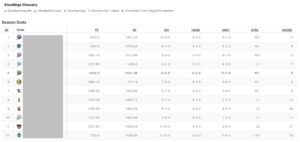
Beyond the win-loss statistics, I find the ‘moves’ category as the most interesting data point to look at. The moves are the number of trades that a specific team makes throughout the season. You can see that the highest number of moves were made mostly by the losing teams.
This makes sense as these losing teams were panicking towards the end of the season, trying to do anything to avoid that terrifying pool-party bill.
Interestingly, and as you probably assumed, most of the guys in this league are in finance. Some work at major hedge funds, others are in real estate, and some manage their own money. Regardless, they all know about risk and the value of owning high quality assets.
Ironically, these same guys also know that choosing high quality assets means you avoid picking a football team that is made up of a few superstars and a bunch of bench players. The team that can last a whole season is much more important than a team that could face annihilation if just a few of their star players get hurt.
Quality and Quantity
I know that you know where I’m going with this story about fantasy football and how it relates to investing.
But we all need to hear it, especially in today’s markets.
The reality is that our world is moving so fast that we all have a visceral feeling to keep up a breakneck pace. The access and frequency of information feeds we’re exposed creates mountains of overwhelming data.
This data motivates us to make daily changes to adjust to a world that appears to be rapidly shifting. And if we don’t make those changes, we face potentially catastrophic risks.
This is taking place in all ares of life, where public sentiment about various topics have done complete 360’s. One example is how politics in the US have drastically morphed into bizarre scenarios where we see the far left and the far right uniting on several topics. This is akin to cats and dogs finding some middle ground of harmony – something that was unthinkable just a few years ago.
Similar scenarios are developing in the investing world where certain styles of capital allocation, say value investing or options traders, are switching up their strategies. You know that something has changed when Berkshire Hathaway is buying Google and Michael Burry has just given up.
What Season Are We In?
When it comes to fantasy football, we know that the season is coming to an end. The winners and losers will be determined and plans for next year’s season will soon be made.
In the investing world, it’s obvious that we’re in the “AI season.” Beyond the non-stop headlines of how our world will be changed by the implementation of artificial intelligence, financial market valuations are heavily skewed towards tech companies.
There’s no doubt that this AI season is extremely important. Certainly on par with previous transformative technologies like the railroad, electricity, or the internet, and probably the most important technology season we’ve ever experienced.
But where we are within this AI season is undetermined.
Late AI Season Vibes
Is it time to be frantically making financial trades, like that last place fantasy football team, in order to avoid losing? Do these trades mean allocating more towards AI? Or should these trades be diversifying out of AI? Today there are powerful arguments for both sides.
From a valuation perspective, it’s clear that AI associated companies are at, or are at least near, full valuations. That’s assuming that forward growth continues to maintain its current trajectory and doesn’t augment up or down.
But simultaneous to the ever-increasing value of AI companies, the opposite is happening in other sectors of the market – sectors that may end up getting more impacted by AI than the AI companies themselves.
These are the second order impacts of artificial intelligence. The companies that have successfully been providing products and services for decades without the assistance of AI. Manufacturing, healthcare, consumer products, transportation, energy, and more.
Many of these companies are actually declining in value due to investor capital being sucked up by the major tech players. These same companies that are becoming less expensive are in fact the ones that stand to have the biggest long term benefits, and are no where near being properly valued once they successfully integrate this new technology into their operations.
Even more, the fully valued AI companies that continue to release increasingly sophisticated products are leaving the rest of the market behind in development progress. New faster, smarter, better versions of various AI products are being launched faster than the second order customers can implement this new tech.
This, I fear, is what will catalyze the end of this AI season.
Silver Lined Transformation
To avoid any misunderstanding, here is what I am saying: The compute power that is being brought to market is beyond what the market currently needs.
This scenario is a textbook boom-bust example of supply and demand economics.
In this AI season, there have already been booms in multiple different tech companies… they’re still booming. Meanwhile, the busts have been everywhere as seen by the underperformance of nearly the entire market beyond the Mag 7 (or whatever they’re called now).
Companies and industries that have been historically bogged down in process and/or data minutiae are about to be completely transformed for the better. These are the same companies that have been recently underperforming.
Healthcare is one example of an industry set to be drastically changed for the better. Incredibly, some of the best health insurance, biotech, medical device, and medical care facilities are trading for single digit multiples with little-to-no debt and enormous demographic tailwinds.
These second order companies are the players you should have on your team to finish out the season.
That’s why I just returned from Canada. To check out the most obvious second order industry that this AI season has somehow forgotten: energy. More on that very soon.